

Pip Release Notes: A Package Search Has a Cache Context
2026-11-03
Pip Release Notes: A Package Search Has a Cache Context
A package search in a robot software deal room is an observation made in a particular environment, not a timeless catalogue of everything available. Pip’s current changelog gives a useful reason to retain that context. The 26.2 release changed handling of package-index caching, while the later 26.2.2 entry, dated October 20, 2026, lists a vendored-library update. A careful summary should not move the earlier cache feature into the October patch.
Read the dated entries separately
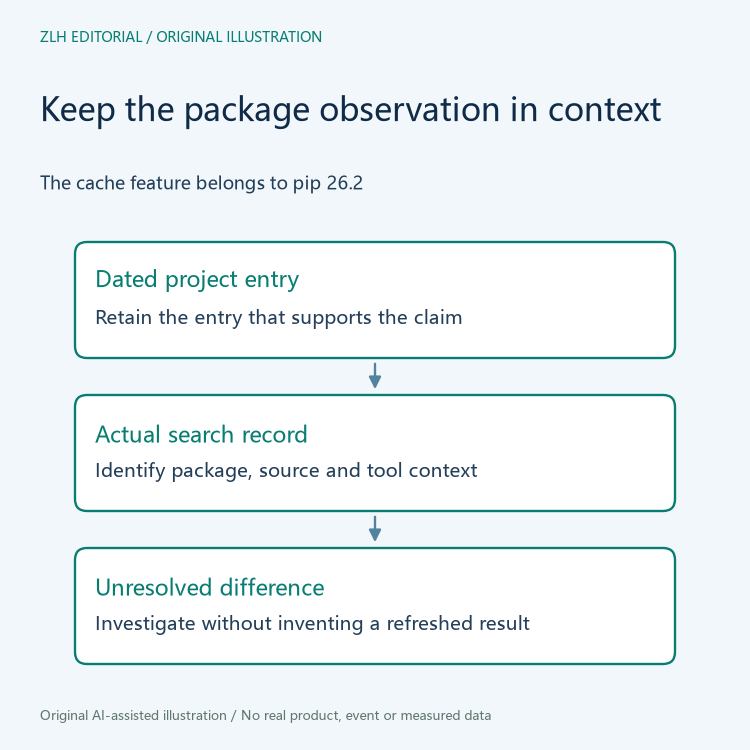
The official pip changelog dates 26.2 to July 29, 2026. It describes caching simple index responses according to their Cache-Control header, with the consequence that a newly published package may not become immediately visible to a client using a caching index. That is the specific behavior relevant to this discussion.
The October patch entry has its own scope. A deal-room note should name the entry that actually supports its statement, rather than collect all changes under the most recent visible date. This is a source interpretation, not a claim that a seller’s environment has been examined or updated.
The present article performs no package search, cache refresh, installation, or network reconfiguration. It supplies no finding about an actual robot software package. Its illustrations identify questions to retain when reading someone else’s record.
A search record needs the question and the environment
For a proposed software handover review, ask which package was sought, which index the record concerns, and which tool context the supplier used. A screenshot showing an available version can be useful without explaining all those conditions. The missing context should remain an open item.
Likewise, a record that does not show a newly announced package does not automatically prove that the package was never published. The documented cache behavior is one reason to investigate the conditions, but it is not a diagnosis of a particular discrepancy. The responsible party needs evidence about its own observation.
Do not remove uncertainty by inventing a refreshed result. A receiving editor can distinguish the supplier’s original observation from a later authorized check, if one actually occurs. Those records should have separate dates and clear relationships.
An installation report is a different document
The official installation-report reference describes the JSON report of what pip installed, or what it would install when used in the documented dry-run context. It explicitly explains that this report format is not itself intended as a lock-file format. A receiver should preserve that distinction.
A search observation, a proposed installation report, an executed installation record, and a lock file can all appear in a delivery folder. Their roles are different. Similar package names in the documents should not cause an editor to treat them as interchangeable evidence.
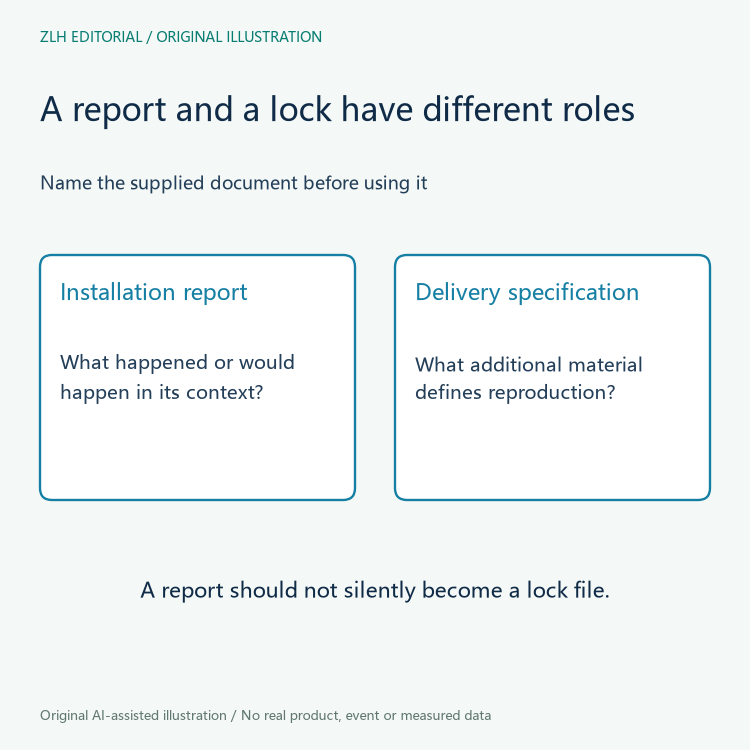
If the supplier calls a report a reproducible delivery specification, ask what additional material supports that claim. The reference gives the report a defined role; it does not establish a complete deployment process for an unidentified controller or application.
Retain evidence without converting it into a guarantee
A deal record should identify which software artifact and environment its observations concern. A package becoming visible in an index does not prove that the supplier installed it, that a delivered robot uses it, or that the supplier will support a resulting configuration. Each further statement needs the corresponding evidence.
The same boundary applies to a later discrepancy. If two parties report different results, preserve both contexts before selecting an explanation. A release note can identify a relevant behavior without proving that it caused the difference. A useful investigation remains attributable to the actual records.
Ask whether the receiving reviewer has the original report or only an editorial summary. A summary may omit conditions that matter to interpretation. Keep its author and relationship to the original clear instead of treating a shortened table as a complete execution record.
No update instruction follows from this review. Changing an environment, its package sources, or its cache policy belongs to a separate authorized activity. The current discussion is about how to read an existing software handover record.
Make the chronology visible to the next reviewer
A concise deal-room summary can say which upstream entry was consulted, which supplier observation exists, and which question remains unresolved. That preserves the chronology without adding a fictional package installation or a broad availability promise.
If new evidence arrives, attach it to the earlier question and identify what changed. Keep earlier observations interpretable rather than silently replacing them with the latest screenshot. This makes the record useful even when tools and package indexes evolve.
Related material appears in our robot software deal section and the document reading directory. The original diagrams contain no actual package search, installation report, software lock, repository credential, or completed deployment result.


