

Robot Software Handover: Read the License Expression
2026-11-04
Robot Software Handover: Read the License Expression
A robot-software handover may contain a familiar license name surrounded by unfamiliar operators. Removing the operators to make a summary shorter can change the statement being conveyed. A license expression should first be read as a complete documented expression attached to a named object. This article concerns terminology and a fictional handover record. It does not determine anyone's rights, assess license compatibility or establish that a delivered system meets its obligations.
Find the package the statement is about
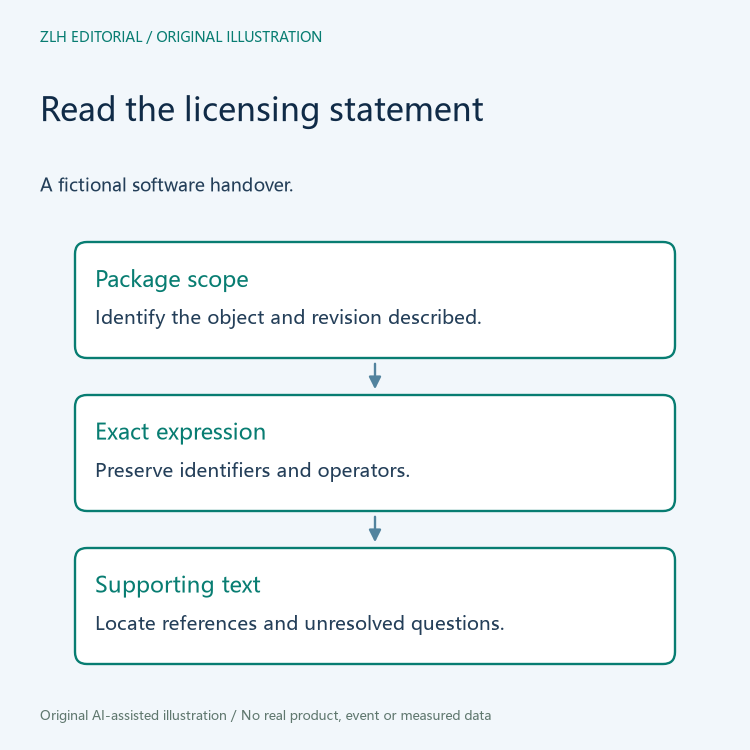
Begin with the object described by the handover. Is the expression attached to one package, one source file or an inventory entry describing a larger component? A license label at the top of a repository page does not automatically explain every separately supplied item. Ask the supplier to connect the expression to the exact package and revision under discussion. Preserve that relationship in the review note rather than collecting license names without their subjects.
Imagine a fictional software delivery containing a navigation component and a separate demonstration asset. The inventory assigns a licensing statement to each. No actual package or commercial transaction is involved. A reviewer should resist merging the two statements into a single attractive label. Their scopes might differ. If the handover omits which entry applies to the demonstration asset, the useful finding is a missing relationship that the supplier can clarify, not a guessed permission.
Retain the operators in the expression
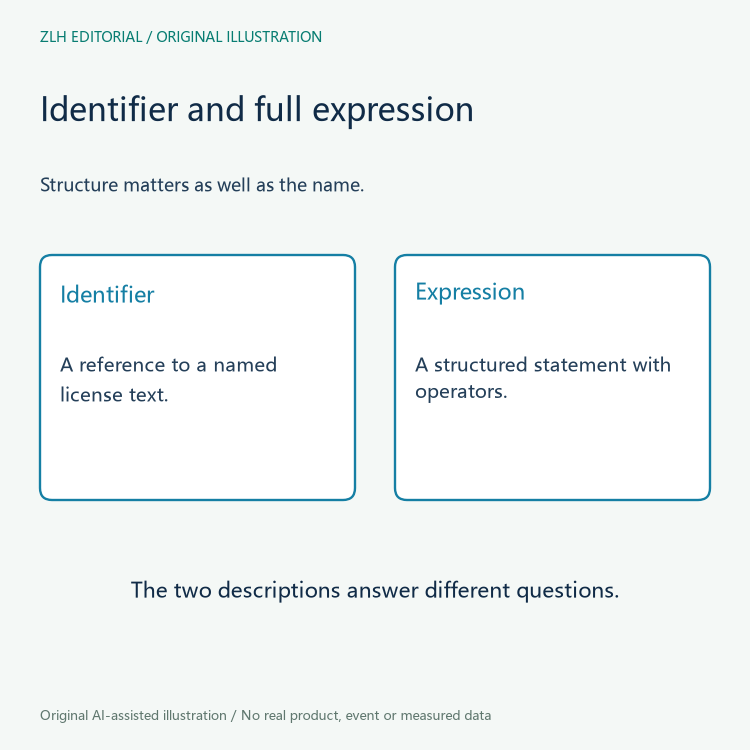
The SPDX 2.3.1 license-expression annex defines operators including OR for a choice, AND for simultaneous requirements and WITH for a license exception. It also provides syntax and parentheses rules. This source explains how a statement is represented. It does not independently verify that a supplier's expression accurately describes every delivered file.
For the fictional inventory, copy the complete expression into the reading note, keeping parentheses and the association with its package. Do not replace AND with a slash or turn WITH into an incidental footnote. A short natural-language summary can accompany the exact expression, but it should preserve the structure. If the summary and expression seem inconsistent, ask the document owner which statement was intended before using either as a delivery description.
Resolve identifiers without inventing their authority
The SPDX License List supplies standardized short identifiers, license texts and canonical URLs, with exception information also linked from the list. Looking up an identifier helps locate the referenced text. Finding a name on that list does not show that a supplier owns the relevant rights or that a particular combination is appropriate for a buyer's intended use.
A documentation reviewer can record which identifier was found and which list version or retrieval context was inspected. If the expression uses a custom reference, ask where its referenced text is supplied rather than silently substituting the closest familiar license. A similar name is not a sufficient mapping. The review should leave a traceable route from the inventory entry to the statement's own supporting material, with unanswered questions kept beside the affected entry.
Separate a copied statement from a reviewed conclusion
A handover checklist often mixes receipt and evaluation. Received license expression means that a statement was delivered. Reviewed package scope means that someone examined what the statement describes. A decision about a proposed use is a further question. These stages need their own attribution. A checked box should not grow into a broader approval merely because later readers do not see the original limitations.
Suppose the fictional supplier replaces a component but leaves its inventory entry unchanged. The reviewer can ask whether the expression was reconsidered for the new component and whether the supporting text still corresponds. This is a documentation consistency question; no infringement or compliance finding is inferred. Preserve the earlier inventory with the earlier delivery so a historical question can be answered without confusing the two states.
Close the handover with an attributable mapping
A useful closing note names the delivered package, its revision, the complete expression, the location of referenced text and the person or team responsible for unresolved interpretation. It also distinguishes what was supplied from what the reviewer actually inspected. If a field remains unexplained, report that gap plainly. A record with a specific open question is more useful than a universal assurance unsupported by its attachments.
The purpose is to keep licensing terminology attached to the correct software object while enabling the appropriate subsequent review. It does not turn an inventory into a condition report for a robot or a guarantee about software support. Our technical information category and related resources category provide broader navigation for handover-documentation topics. They are category routes, not specific legal assessments or certifications of an individual deal.


