

Robot Deal Lists: Review Add-on and Included Objects
2026-11-04
Robot Deal Lists: Review Add-on and Included Objects
An add-on shown beside a robot deal can be easy to mistake for an included item. A document pack should explain whether it describes an additional offer, a component included in the base offer or a delivered object. Those are different reading questions. This article uses fictional catalogue material and Schema.org vocabulary to organise them; it does not interpret a contract, quote a price or confirm any real transaction.
Identify the relationship shown in the catalogue
Imagine a fictional catalogue page with a robot entry and an adjacent software-support card. The layout alone does not explain whether the second card is included, separately offered or simply related reading. A reviewer should preserve the labels and ask the provider to describe the relationship explicitly. Visual proximity can help navigation, but it does not supply an inventory statement or the missing scope of an offer.
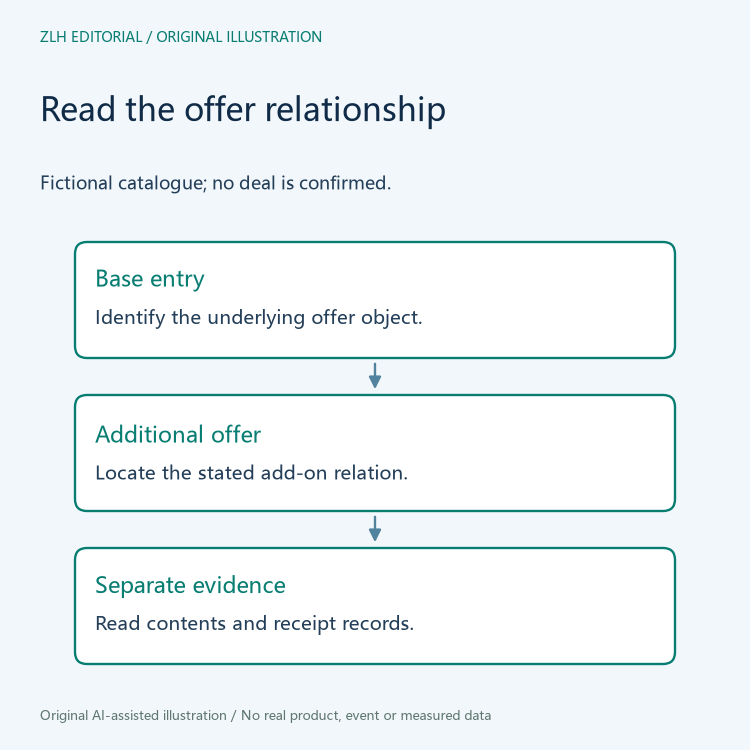
Register the base entry and additional card as separate document objects until their relationship is explained. Keep their versions and references available. If the provider uses a structured vocabulary, ask which relationship it intends to express. If it uses only prose, the prose still needs to identify the objects. An editor should not introduce a relationship merely because it makes the catalogue easier to summarise.
Read add-on as an additional offer relationship
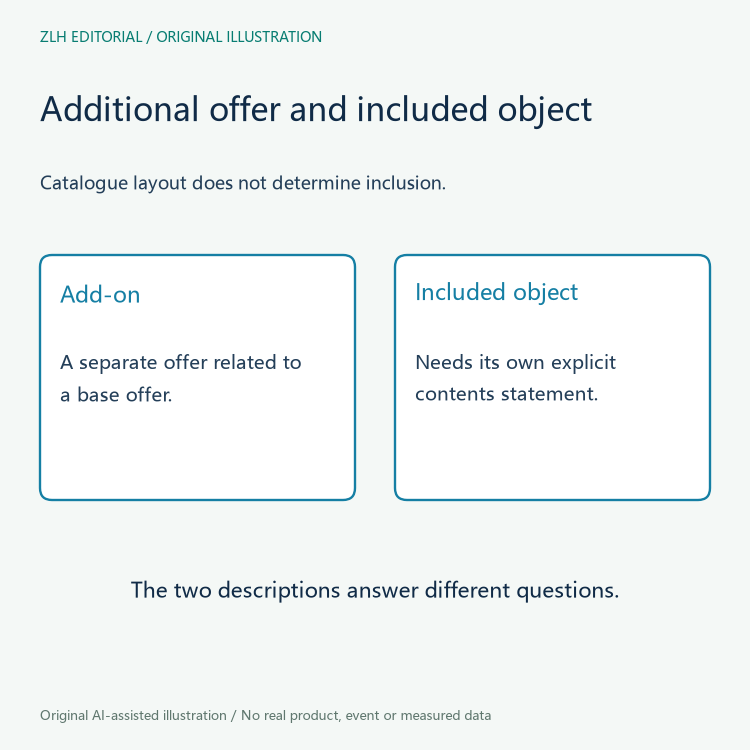
The Schema.org addOn property describes an additional offer obtainable only together with a base offer, giving supplements and extensions as examples. It links one Offer to another Offer. The inspected page is the development vocabulary version. This is a reference for structured description, not evidence that a particular support item is included, available or supplied by a verified provider.
In the fictional pack, a reviewer could ask which offer is the base and which is additional. The explanation should preserve both ends of the relationship. It should also avoid assuming that an add-on is a physical accessory: the vocabulary describes offers, so the nature of the offered item or service needs its own description. Do not replace that description with an image of a plausible accessory.
Read included-object information as another statement
The Schema.org includesObject property links to nodes indicating the quantity of products included in an Offer or ProductCollection. That is a different relationship from an additional offer. Reading the two vocabulary entries together helps a document reviewer ask what the provider actually means, without concluding that vocabulary markup itself proves physical inclusion or delivery.
For the fictional list, request an explicit description of the base contents and the additional offer separately. Do not infer that every adjacent card is included in the quantity statement. Conversely, do not label an included component as an add-on merely because it has a separate line in the document. The relationship must come from the provider's explanation and the material being reviewed, rather than from line breaks or card styling.
Keep the offer description separate from the received set
A catalogue relationship says how something is offered or described. An actual receipt record concerns what was received. The fictional handover should identify any delivery list separately and show how it relates to the offer version. This article has no receipt evidence, so none of its diagrams can establish that a robot, accessory, software entitlement or support service has been delivered.
If the list later changes, preserve which relationship changed. An additional offer might be added to the catalogue without changing the base contents. A base-content correction might require a different explanation. Neither event should be narrated as an observed shipment change without corresponding records. Naming the relationship makes the revision question much more specific for the next person reviewing the pack.
Accept a document explanation with unresolved scope visible
A useful finding can state that the provider has identified a base offer, an additional offer and any separately documented included objects. It should list missing descriptions and leave delivery questions open where evidence is absent. This is a documentary review, not an assurance about commercial rights or a substitute for the parties' actual agreement. The finding should remain readable without importing unstated terms.
Keep a short example of the relationship alongside the review note, with the fictional or illustrative status clearly marked. That gives future editors an explanation to maintain rather than a generic checked box. If the provider's terminology differs from the vocabulary used here, preserve its terminology and ask for the mapping instead of silently rewriting its intended scope.
Further reading is available through the technical material category and related resource category. These categories do not validate offers. The practical value of the distinction is a document pack that says which objects and relationships it describes, while retaining a separate place for inventory, receipt and other evidence.


