

Robot Deal File Maintenance: Read Rename Detection
2026-11-04
Robot Deal File Maintenance: Read Rename Detection
Rename detection in a robot software document pack can help explain why a file appears under a different path. It is not a self-contained record of the author's intention or a physical handover event. A maintenance reviewer should retain the comparison context and the files being related. This article reads official Git documentation through a fictional deal-room package. It does not execute Git, modify a repository or verify a software delivery.
Name the two compared versions and paths
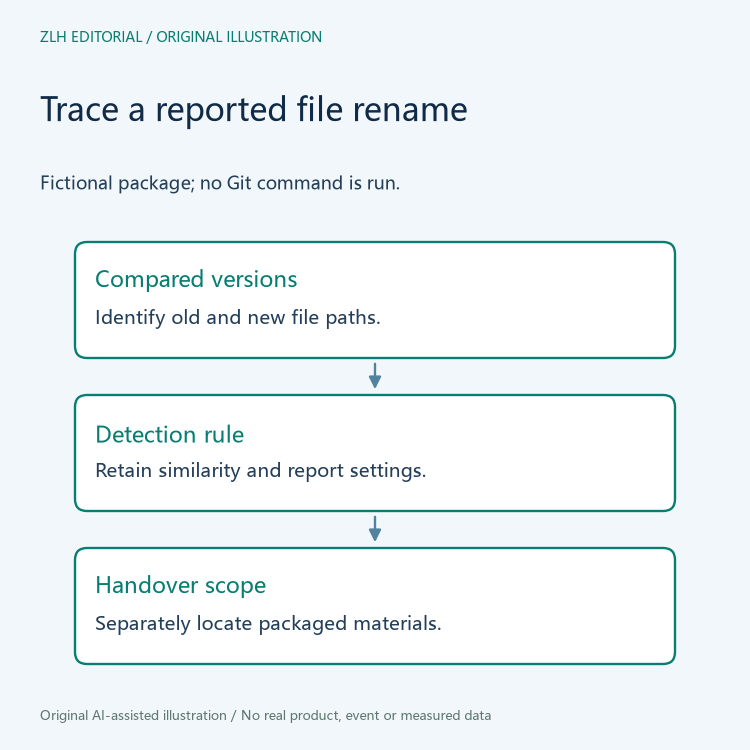
Imagine a fictional package whose current guide appears under a new filename. A report marks an earlier file as renamed, but it does not identify the compared versions or settings. The reviewer should request those details before treating the label as a complete history. A file path is part of a repository snapshot; the relationship between two paths needs a documented comparison rather than a guess based on a similar title.
Retain the old and new paths exactly as supplied. If the report is only a cropped image, preserve that scope and ask for the surrounding context. Do not invent a commit identity or declare that no content changed merely because the new name looks like a spelling correction. The maintenance record should identify what was compared and what evidence accompanies the reported relationship.
Read similarity-based rename detection as a comparison rule
The official git-diff manual describes rename detection using a similarity threshold, and distinguishes exact rename detection through a full-similarity setting. This means a rename label can coexist with content differences depending on the comparison settings. The manual explains the tool's rule; it does not establish what a particular repository author intended or which settings a provider used.
For the fictional pack, ask whether the provider's report allowed similarity-based matching and what the associated difference shows. Do not translate a rename label into unchanged contents without supporting material. Conversely, a missing rename label does not settle whether the author intended a move. The reviewer should preserve the reported detection and the provider's explanation as distinct statements, each with its own source.
Read history following with its stated limit
The official git-log manual explains that follow continues a file's history beyond renames and works for a single file. A handover note should identify that scope rather than presenting one file's history as an audit of the entire package. Other history selection and simplification choices can also matter, so a provider should preserve the report context rather than only its most convenient lines.
A fictional provider might supply a history excerpt for a renamed guide. The reviewer should ask which file was followed and which version the excerpt begins from. It is not necessary to run a command to recognise that documentation need. If the provider claims the whole software inventory was examined, request evidence appropriate to that larger claim instead of stretching a single-path report to cover it.
Keep repository changes separate from delivered materials
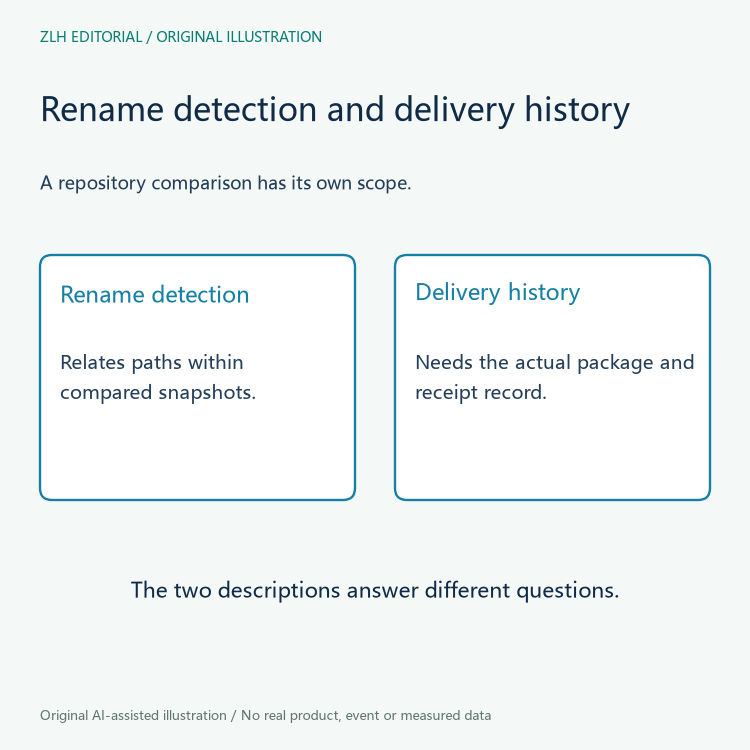
A repository comparison concerns source snapshots. It does not prove that the same revision was included in a deal-room download or received by another party. The fictional maintenance record should identify any packaged copy and its relationship to the source version separately. A renamed guide in a repository is not automatically the guide that accompanied a robot or a software entitlement.
If a document title stays the same while its path changes, preserve both roles. The title helps a reader identify the document's intended subject; the path locates it within a particular snapshot. Neither should silently replace the other in an inventory. A later reviewer needs to understand why an old reference now points elsewhere and whether the provider has documented the relationship to the delivered set.
Write the maintenance explanation without filling gaps
A useful finding states the compared versions, old and new paths, supplied detection settings and scope of the history excerpt. It should separately record any content review and package relationship. If those materials are missing, preserve that uncertainty. This article reports no actual rename, content identity or transfer; its fictional scenario only identifies the questions a clear maintenance note should answer.
Retain the original report when a clarification arrives. Replacing an ambiguous label with a better explanation should not erase the material that prompted the clarification. The next maintainer can then see how the interpretation was reached and revisit it if another revision changes the relationship between the repository guide and the packaged documentation.
Further methods appear in the technical material category and related resource category. These category entrances do not authenticate a deal-room package. Reading rename detection at its actual comparison scope gives the software-document history a clearer meaning while keeping delivery claims attached to delivery evidence.


