

Used Robot Camera Records: Timed and Trigger-Width Exposure
2026-11-05
Used Robot Camera Records: Timed and Trigger-Width Exposure
Exposure information in a used robot camera offer needs a mode as well as a value. Basler documents different ways to determine how long an exposure lasts. A time setting has a particular role in Timed mode, while a hardware trigger signal's width supplies the duration mechanism in Trigger Width mode. An offer that lists only an exposure number may leave that interpretation unresolved. This article reads the manufacturer documentation, without changing a camera setting, applying a signal or assessing an installed vision system.
Begin with the duration mechanism named by the source
The official Exposure Mode documentation concerns how exposure length is determined during triggered image acquisition. Its Timed description ties that length to the camera's exposure time setting. Its Trigger Width description ties the length to the width of a hardware trigger signal. Those are distinct explanations of duration, even when a sales sheet puts both under the same heading.
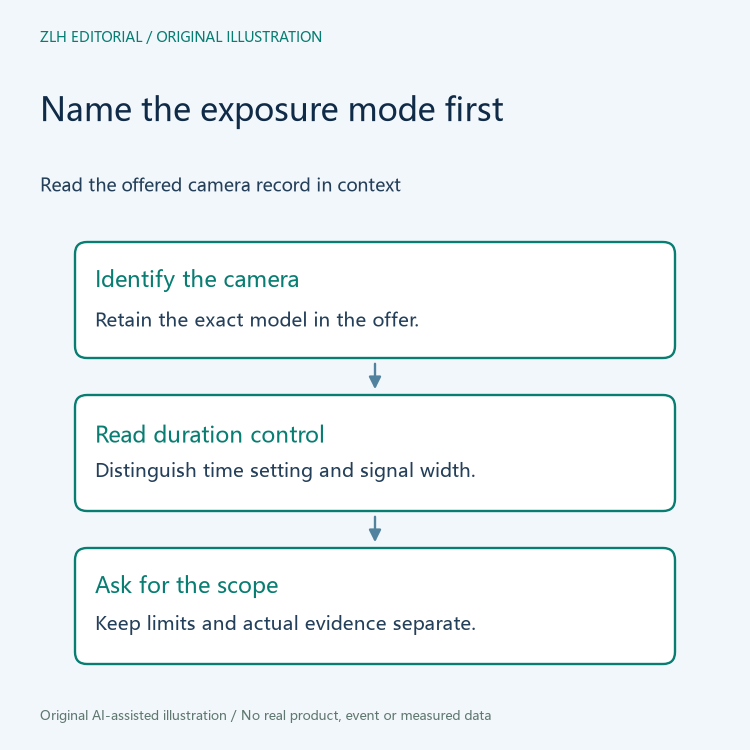
A buyer should retain the exact camera model and the stated mode before interpreting a value copied from a screenshot or quotation. The documentation includes model-specific availability. A feature listed for a product family should not silently become an inclusion for every camera offered with a robot. If the offer does not identify the mode, preserve the missing detail as a supplier question.
Read Timed without turning it into a whole-system result
In the documented Timed mode, the exposure time setting defines how long exposure continues. That explains the role of a parameter in the stated mode. It does not establish an unknown camera's current setting or the quality of a captured image. A procurement note can identify the relevant feature and ask for the offered configuration, while keeping actual image evidence separate.
Consider a fictional quotation containing a camera screenshot with an exposure-time value but no mode label. Calling that number the demonstrated exposure duration would omit the configuration question. A useful request asks which camera and mode the screenshot represents. This invented example contains no real equipment, image capture or measured timing result. It shows why a copied parameter needs its own context.
Read Trigger Width with its documented qualifications
The Trigger Width description explains duration through the hardware signal's width. The same page separately describes exposure time offsets on some camera models and supplies model-specific information. A buyer should therefore avoid promoting a short conceptual description into an exact timing guarantee for every product. The mode and the applicable qualifications belong together in the reading record.
The page also describes a separate Trigger Controlled mode. This article focuses on the two duration mechanisms in its title and does not imply that they are the only modes in the manufacturer's documentation. It gives no sequence for selecting a trigger source, setting a duration or compensating an offset. Those operational details are outside this document-reading discussion.

Keep the exposure-time page beside the mode explanation
The official Exposure Time documentation explains the exposure-time feature and includes camera-specific ranges and parameter availability. It also distinguishes the set value from effective exposure time in relevant model contexts. These details make the camera identity material to a quotation review. A value without a parameter name and applicable model information can be difficult to interpret accurately.
Do not merge similarly named features merely to shorten a sales table. ExposureMode and the separately discussed exposure-time mode options have their own roles in the documentation. A reviewer can retain the original parameter names and ask which one an informal phrase refers to. This approach preserves the supplier's actual statement while giving the supplier a concrete ambiguity to resolve.
Ask for evidence tied to the offered camera
A useful enquiry identifies the offered camera, names the mode claimed in the quotation and asks which document explains the accompanying duration statement. If performance evidence is also requested, keep its configuration and observation scope visible. A feature definition explains terminology; it does not certify compatibility with the robot or establish that the complete application meets an image-quality requirement.
For an existing record, preserve the original screenshot or table and the source used to interpret it. If later information establishes that a different mode was in use, describe the resulting change in interpretation rather than silently relabeling the old value. This keeps the history reviewable without making an unsupported finding about the condition of the used camera.
Both Basler pages were read on November 5, 2026. Their model-specific qualifications remain part of the source context. The two illustrations are original conceptual aids, without a real timing waveform, product likeness or measured result. Related reading is available in the robot equipment trading collection and article directory. A clear Exposure note identifies what determines duration before a buyer compares values across offers.


