

Used Robot RTDE Records: Integer Register Ranges
2026-11-05
Used Robot RTDE Records: Integer Register Ranges
Integer Register Ranges are part of the meaning of an interface appendix in a used robot offer. Universal Robots distinguishes a lower range reserved for Fieldbus and PLC usage from an upper range reserved for external RTDE clients. A table that labels every integer input register simply “available” loses that distinction. This article reads the manufacturer's references without connecting to a controller, reading a register or changing any interface configuration.
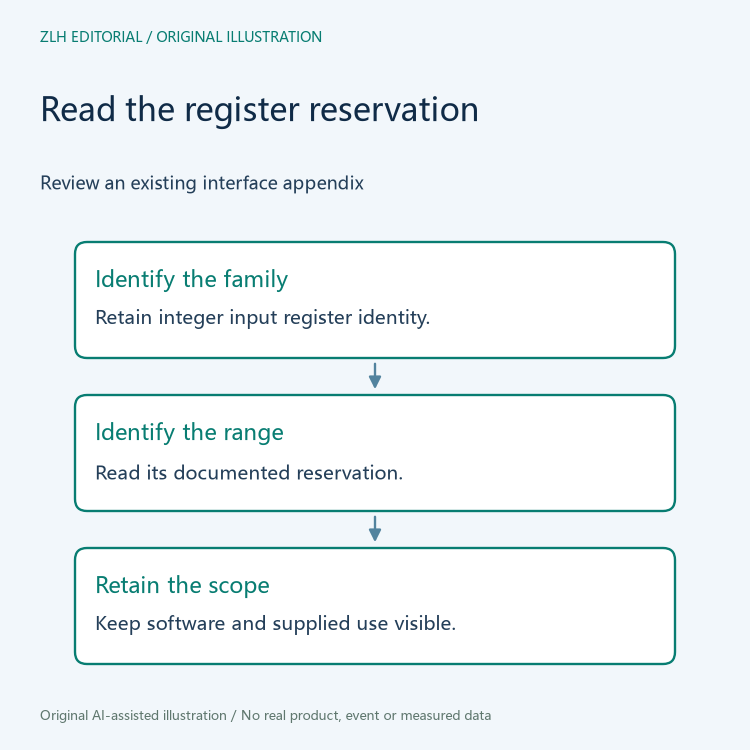
Identify the register family before interpreting its address
An address alone does not identify the complete interface object. The supplied record should say that it concerns an integer input register and retain the original field or function name. A similarly numbered bit, double or output register belongs to a different documented family. The number should not be detached from that identity when a seller's table is reformatted for a buyer.
The review can begin with the existing appendix and its stated software context. Ask which source explains the register assignment and which equipment configuration the appendix concerns. If the seller supplies only an address and an informal label, record the missing identity. Do not infer a complete register map from a familiar number or from the title of the offered robot.
Read the RTDE table's integer input reservation
The official RTDE Guide identifies input_int_register_X as an INT32 family of 48 general-purpose integer registers. Its comment separates addresses 0 through 23, reserved for Fieldbus and PLC, from addresses 24 through 47, reserved for external RTDE clients. The table also associates the upper range with introduction version 5.3.0.
The phrase general purpose should therefore be read together with the reservation in the same row. It does not establish that any application may use every address without regard to the documented interface role. Nor does the row report what a particular installed application currently assigns to a register. Those are different questions for the supplied configuration account.
Cross-check the manual's address explanation
The official SW5_19 integer input register reference gives an address range from 0 to 47 and repeats the lower and upper reservations. It explicitly says that Fieldbus and PLC interfaces cannot access the upper range because that range is reserved for external RTDE clients. This corroborates the distinction for the manual route being read.
The reference includes an executable example, but this article does not reproduce it as a handover action. A recipient can ask which range a supplied assignment belongs to without performing a new read or write. The source supports the reservation explanation; it does not establish that the offered controller has been connected, inspected or tested during this document review.
Separate reservation from actual assignment
A reservation describes the documented interface role of a range. An assignment account describes what the particular application uses an address to represent. A handover needs both when it makes a claim about an existing interface. Knowing that an address falls within the external-client range does not reveal the meaning assigned to its integer value by a particular application.
Likewise, a supplier's word “free” needs an explanation. It might intend to describe a currently unassigned application field, but that is not the same statement as the manufacturer's reservation. Retain the supplier's wording and ask what evidence supports it. Do not turn a range classification into a claim that no other software uses the address or that a proposed integration is compatible.
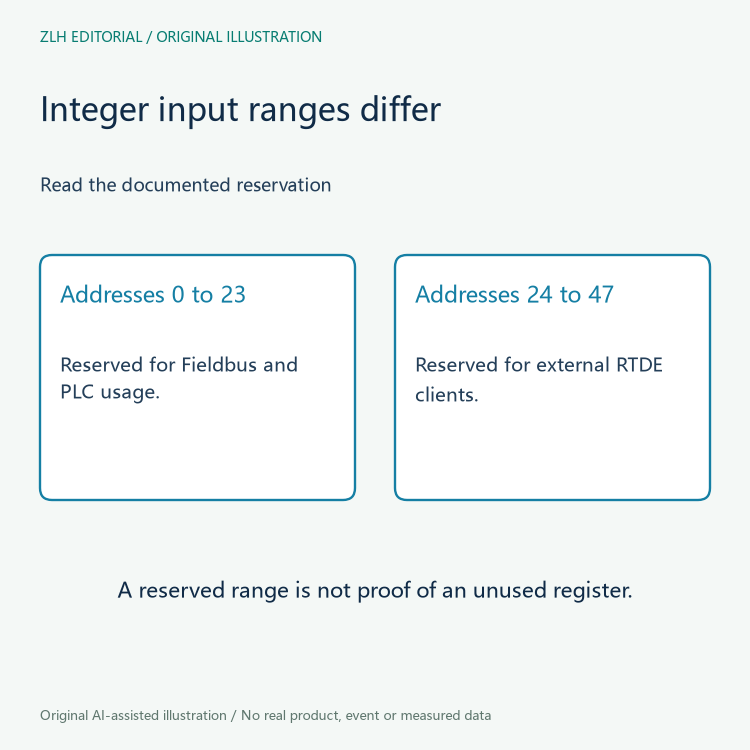
Review a fictional interface schedule
Imagine a fictional offer containing an integer input schedule with two groups of addresses. Its summary labels the entire schedule “PLC inputs,” while the documented upper group is reserved for external RTDE clients. The reviewer should ask the contributor to explain the labeling and preserve the original schedule. This invented example describes no actual controller, register value or communication failure.
A useful correction would identify the documented range roles and separately explain the application's intended assignments. It should not silently renumber registers, rewrite a program or claim that a communication test has passed. If the supplier's explanation remains incomplete, the review can report that limited finding without diagnosing a hardware fault or approving a new interface design.
Preserve the software and evidence boundaries
The current guide and the SW5_19 manual route were read on November 5, 2026. Keep those contexts distinct from the software version of any offered robot. A current reference can explain a field while an older attachment still needs its own applicable documentation. A document-reading article does not grant permission to change access settings, establish a connection or allocate live registers.
The two original figures show conceptual range roles without packet traffic or a real register map. Related material is available in the used robot interface collection and article directory. Keeping the family, range reservation and application assignment visible gives the recipient a precise question to resolve before treating an interface appendix as a complete account.


