

Used Camera Action Records: Group Key and Group Mask
2026-11-05
Used Camera Action Records: Group Key and Group Mask
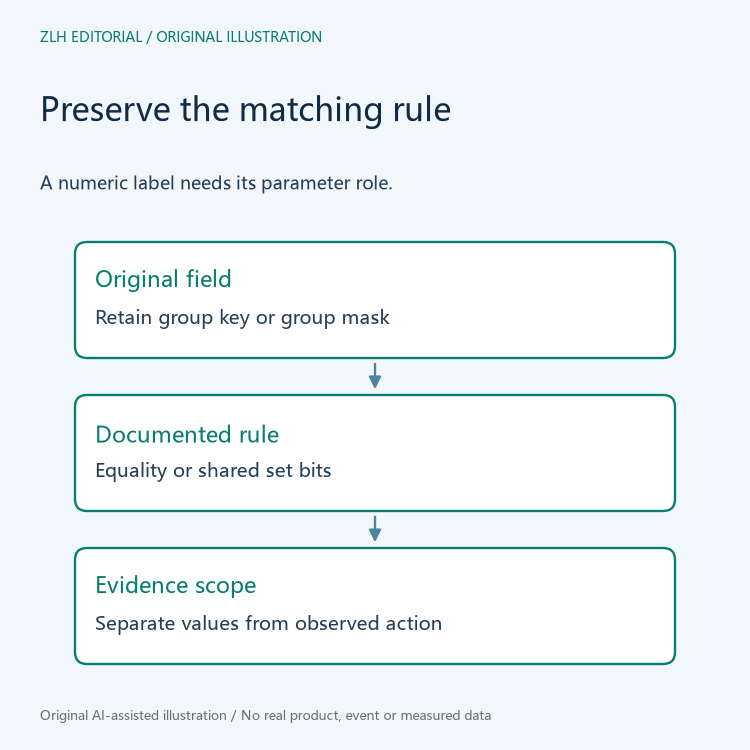
Camera Action Records in a used vision-accessory offer should preserve the difference between a group key and a group mask. Both are numbers in Basler's action-command account, but the documented matching rules differ. A group key identifies a group through equality, while a group mask filters a subgroup through shared set bits. This article reads existing manufacturer material and a fictional handover appendix. It sends no action command, supplies no working key or address and changes no camera.
Locate the group key's equality rule
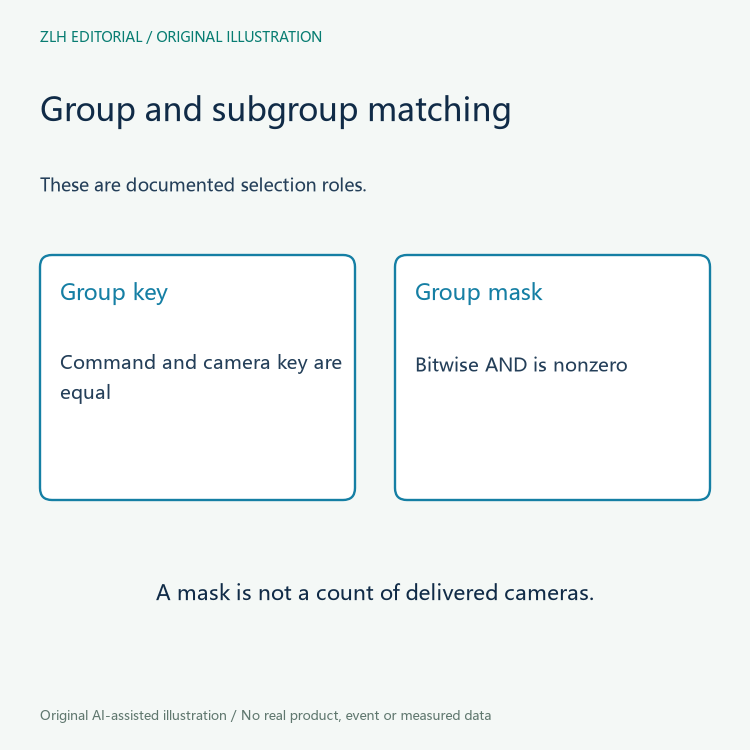
The official Basler Action Commands reference describes ActionGroupKey as defining a group of devices. The command's group key and the camera's group key are compared for identity. A handover note should retain the parameter name and its documented role rather than turn every numeric field into a generic group number.
In a fictional used-camera pack, a contributor may provide a table of action-related fields. The editor can identify a row labelled group key and ask which offered camera context it describes. The existence of such a row does not establish that a command was received or that an action occurred. The manual explains a selection mechanism, while a real execution claim needs evidence from the relevant system.
Read the group mask through shared bits
The same reference describes ActionGroupMask as filtering a subgroup. Its rule is a bitwise AND between the command mask and the camera mask, with a nonzero result indicating subgroup membership. In other words, the documented rule requires a shared set bit; it is not simply the group key's exact-equality rule repeated under another label.
A fictional reviewer who sees different mask values should therefore avoid declaring a mismatch solely because the displayed numbers differ. Equally, an editor should not infer a successful selection without the actual corresponding context. This article gives no numerical mask example and performs no bitwise calculation. It only preserves the manufacturer's distinction between equality and subgroup filtering.
A mask is also not a count of cameras. Reading its decimal display as the size of a delivered group would change the kind of information the field represents. The inventory count should come from its own equipment records. No real camera count or network layout has been supplied here, and none is reconstructed from the documented mask concept.
Keep the other action parameters in view
The Action Commands reference separately describes a device key and a broadcast-address context. Its account requires applicable protocol information and camera configuration to match. The group-mask rule should therefore not be isolated and rewritten as the only condition for any camera action. A subgroup explanation is narrower than a complete account of command handling.
The article also distinguishes ordinary action commands from scheduled action commands and identifies feature-support conditions. Those topics are not a reason to infer exact synchronization from a group label. The present review assesses no timing, authorization boundary or equipment suitability. It contains no operating sequence and does not propose how an action source should be configured.
Read the viewer terminology as documentation
The official pylon Viewer Action Commands page repeats the distinction: Group Key defines a group, and Group Mask filters a subgroup from that group. It also explains how the viewer's displayed parameter entries relate to camera configuration. A saved pane or screenshot therefore needs its own context before it is treated as proof of values applied to the camera.
For the fictional offer, a useful enquiry asks whether the supplied document is a reference example, a user-interface entry or a retained account of camera configuration. These are different evidence objects. A field visible in a manual example is not the current value of an offered accessory, and a correctly transcribed name is not a demonstration of the mechanism.
Write a handover note that preserves the rules
A clear note can retain the full parameter names and describe which fields use equality and which use subgroup filtering. It should keep the camera model, applicable documentation and source material connected to that explanation. If the contributor has omitted the relationship between a screenshot and an accessory, list that gap instead of filling it with a likely-looking configuration.
If a later revision repairs the label group count to group mask, identify the change as a correction of the document's interpretation. It does not mean cameras were added, removed or reconfigured. An actual equipment change would need its own record and should not be inferred from the editorial revision alone.
The original illustrations show no real keys, addresses, masks or command traffic. Related reading appears in the used robot vision records category and component reference category. Camera Action Records remain clearer when group-key equality and group-mask filtering keep their separate documented meanings throughout the transaction appendix.


